






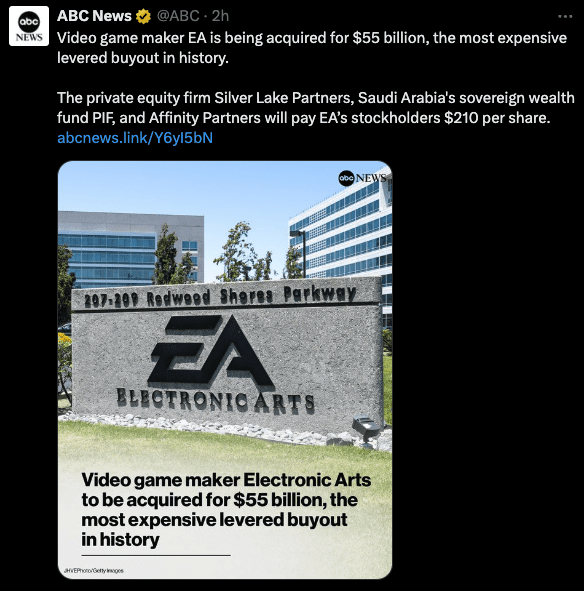
Electronic Arts (EA) will go private in a US$55B all-cash deal led by Saudi Arabia’s PIF with Silver Lake and Affinity Partners.

Electronic Arts (EA) will go private in a record-setting US$55 billion all-cash buyout led by Saudi Arabia’s Public Investment Fund (PIF) with Silver Lake and Affinity Partners.
EA stockholders will receive US$210 per share—about a 25% premium to the September 25 closing price of US$168.32—with closing targeted for EA’s fiscal Q1 2027 pending approvals.

The PIF will roll over their existing 9.9% stake. The consortium is backing the deal with roughly US$36 billion in cash (including the rollover) and about US$20 billion in debt arranged by JPMorgan, with $18 billion financed at closing.
EA will be delisted, remain headquartered in Redwood City, and Andrew Wilson will continue as CEO.
For esports, the headline is scale and certainty.
Private ownership under a capital-rich group gives EA the flexibility to make multi-year commitments to prize pools, venues, and broadcast partners—key ingredients for stable betting markets and predictable event calendars.
Expect tighter league operations, more consistent seasonal windows, and stronger data distribution across EA’s flagship competitive titles, which should translate into deeper market offerings and fewer last-minute schedule changes.

EA’s portfolio touches nearly every corner of competitive gaming.
EA Sports FC (formerly FIFA) anchors global football esports and the publisher’s most reliable annual cycle.
Madden sustains a mature North American ecosystem with recurrent engagement and in-season American football content drops.
Apex Legends supports a robust, international circuit via the Apex Legends Global Series, with strong viewership in North America, EMEA, and APAC.
Battlefield—with a large-scale multiplayer scene—remains a tentpole shooter poised for renewed attention as EA invests in new releases.
Beyond esports-first titles, franchises like The Sims and Need for Speed broaden reach and cross-sell potential, while Respawn and BioWare properties (Star Wars Jedi, Titanfall, Dragon Age, Mass Effect) provide blockbuster anchors for live-ops tie-ins, creator campaigns, and event sponsorships.
The upside for the wagering ecosystem is straightforward. Expect larger, earlier-announced events, richer prize pools, and stronger integrations between publishers, tournament operators, and sportsbooks.
The risk is centralization—more top-down control over formats, locations, and IP usage—which could compress third-party tournaments and concentrate visibility in publisher-run circuits.
Ciaran Jackman
Senior Esports Editor
Ciaran Jackman spent six years as a senior editor at EsportBet.com, publishing nearly 1,000 articles across CS2, VALORANT and League of Legends. A mad esports fan and one of the hardest working people in the organisation, Ciaran was a defining voice on the site from 2019 to 2025.